
Instandhaltungssoftware für Industrie, Versorger und Windkraft
With GreenGate’s (D/CH) GS-Service software suite as its intelligent data hub, SIMON GROUP gets the people, machines and processes working together more effectively and sustainably. The mobile app GS-Web in particular brings the Swabian company tangible maintenance benefits for four companies on site. Teams can plan better with overviews of completed and outstanding tasks, schedule personnel more efficiently, prepare for audits simply and consistently, and spot the cost drivers in their machine park. The improvement is plain to see.
SIMON GROUP employs around 740 people and is headquartered in Aichhalden near Schramberg (Baden-Württemberg). The company group, which belongs to the publicly listed INDUS Holding AG, evolved from the company Karl Simon, founded in 1918. Under the umbrella of SIMON GROUP, four companies are united: Karl SIMON GmbH & Co. KG, BETEK GmbH & Co. KG, SIMON Sinterlutions GmbH & Co. KG, and SITEK – A BETEK BRAND, as well as the business divisions SIMON Tooling and SIMON Analytics. In addition to the main plant in Aichhalden, BETEK operates a production site in Taicang, China, and maintains a sales office in the USA.
GS-Service – GS-Manager; GS-Web
Comprehensive support for process analysis and concept development; implementation of the maintenance system; support for initial data entry; joint development and end-user training (key users); customizing, support
The product portfolio is characterized by carbide-tipped wear tools for road construction, mining, crushing/mixing, and agriculture. In addition, the SIMON GROUP produces series-manufactured metal powder parts for the automotive industry, power tools, and mechanical and plant engineering. The Group’s core competence is sintering. With sintering technology, complex geometries can be produced with high precision while avoiding material-intensive machining steps. The in-house toolmaking department, SIMON Tooling, develops, designs, and manufactures the company’s own tools and also offers its services to external customers. SIMON Analytics is a materials laboratory equipped with state-of-the-art instruments that is indispensable for quality assurance within the SIMON GROUP and also acts as a service provider for external customers. Maintenance within the Group is organized centrally and is carried out by the Technical Services (TD) department for all companies that run their operational business in neighboring production halls. Since 2019, 50 employees, including industrial mechanics and electronics technicians, have been handling servicing, maintenance, and repair with digital support.
Marcin Schulz, Team Leader Technical Services Mechanics, still remembers how maintenance was originally handled: “Everything was done by word of mouth – someone would call to say the machine wasn’t working and ask if we could take a look.” Reactive maintenance with rapid fault rectification was certainly a common and justifiable strategy across industries for decades – especially when latency was a secondary concern and longer production downtimes did not really matter. With the advent of IT, however, rationalization got underway, and with it the optimization of all assets and processes. In the 2010s, the full-scale digitalization of the SIMON GROUP, with its distributed production facilities requiring maintenance and its growing operational business, also reached maintenance.
Exactly the right decision, as maintenance expert Prof. Lennart Brumby explained in an interview with the trade magazine ‘Produktion’ in August 2024: “We definitely need to move away from reactive work. If I’m more predictable, if I act proactively, I can prepare for the tasks at hand. I can approach it much more smartly.” Dennis Schneider, Team Leader Technical Services Central Warehouse at SIMON GROUP, agrees: “Maintenance may be the ‘fire department’ in-house, but we definitely want to move more toward planned maintenance – with GS-Service, we have already made good progress.”
What exactly does GS-Service, in use at SIMON GROUP since 2019, deliver in the field of maintenance and facility operations management? The software is an organization and control tool that enables companies to plan, schedule, control, document, manage, and evaluate their operational business on a single platform. Depending on requirements, the application runs on mobile devices and/or at fixed workstations. GS-Service is the name of the software suite as a whole, with GS-Manager (desktop) and GS-Web (mobile application) as its core applications. The object-oriented software, designed as a scalable client/server solution, is built on standard technology and runs on current Microsoft operating systems. Thanks to its open system architecture, GS-Service can be connected to other systems (GIS, ERP, DMS, etc.).
In the beginning, GS-Service at SIMON GROUP serves as the central data source, the so-called “Single Source of Truth”: it contains all machines and systems of the five companies, all equipment, the relevant employee data, and the maintenance processes that keep day-to-day operations running. Dennis Schneider explains: “A wide variety of systems are documented in GS-Service: from the large systems in the explosion-protected area and powder production to presses that shape the powder, vacuum furnaces, continuous furnaces, presses for calibrating the parts, and the machines for vibratory finishing, as well as testing machines and in-house builds from plant engineering – everything is recorded. The same applies to equipment, including PPE, oil drip pans, the more than 500 ladders and step stools in the plants, and around 200 industrial trucks.” The ERP is used to mirror objects, systems, orders, and articles, but nothing more: “The ERP itself was completely useless for our maintenance,” says Marcin Schulz. For this reason, in 2017 the Swabian company evaluated four expert systems for maintenance and also visited a GreenGate reference system in Switzerland. In addition, there were good discussions “always on an equal footing” with GreenGate IT on topics such as interfaces and master data management. The test system installed at the end of 2018 was convincing, as was the go-live in February 2019, initially on a trial basis in one plant for three months. “The system runs well, and it has to,” comments Dennis Schneider.

Just to operate a forklift and a crane, you need, among other things, a license, initial instruction, the annual refresher instruction, authorization from the company, etc. Or, for work orders for colleagues with a hot work permit, the fire alarm system has to be switched off. Here, a risk assessment covering areas, processes, and persons is built into GS. The information block is added to the work order automatically.
Dennis Schneider, Team Leader Technical Services Central Warehouse, SIMON GROUP
Smart maintenance handling based on GS-Service at SIMON GROUP today starts out very down to earth: “We now work largely paperless – every technician in mechanics, electrics and plant engineering, or logistics, has a tablet,” says Marcin Schulz. “Colleagues have all their tasks pushed to their tablets. On an intuitive user interface, the technician sees which planned and unplanned maintenance tasks are pending, including checklists.” What’s more: “Everyone can access critical spare parts lists needed at the machines. You can look up what has been done and open PDFs with circuit diagrams, plant drawings, and inspection data such as UVV (German accident prevention regulations), TÜV, etc.” However, this has only been the case since 2022. In the interim, maintenance used a hybrid approach. Marcin Schulz explains how it worked: “We printed paper tickets with barcodes from GS-Service so that we could also book out material and assign it correctly to the respective service objects. So each employee received their task and barcode, etc. in paper format.” The system worked because, although it was more laborious than a purely digital approach, it was strictly geared toward practical use: via the feedback number, costs, spare parts, and effort were later booked directly to the machine when the data was transferred manually into GS-Service. The work order sheet also contained details about the machine (location, machine type), directly below it the task or fault description, as well as predefined activities (checklists) and computers accessible to authorized users in the immediate vicinity of the point of repair.

We now work largely paperless […] our colleagues have all their tasks sent directly to their tablets. On an intuitive user interface, the technician can see which planned and unplanned maintenance tasks are due, including checklists.
Marcin Schulz, Team Leader Technical Services Mechanics, SIMON GROUP
With the launch of GS-Web, the mobile GreenGate application for maintenance and facility operations, SIMON GROUP had the opportunity to achieve end-to-end digitalization without analog intermediate steps. The browser-based system (intranet/internet) maps processes completely in role-based modules: from capacity-based work order planning, job preparation and area-based dispatching, through mobile work order processing, defect recording and incident reporting, to the analytical evaluation of technical and commercial KPIs. Synchronization with the central database takes place automatically and in real time. This means that, since 2022, manually transcribing handwritten work order sheets has simply been eliminated at SIMON GROUP. It also means, however, that technicians are across the board required to work with digital support. In practice, this means that planning and task assignments are sent automatically to the technicians via tablet. The task list includes, for example, scheduled recurring work such as inspection rounds that check supply lines for compressed air, gases, cooling water, etc., or repair orders that the shift supervisor submits after production downtime, a defect, or an incident.
Depending on the order, activities are guided by checklists. Either way, every machine (clearly identifiable on site by its label number) is a service object. Tasks are booked to the service object accordingly, and the service object links to the filing system where circuit diagrams, manuals, and images are stored, in each case whatever the respective team leader considers relevant. Finally, technical and commercial feedback is also submitted via the IT system. Before any work is carried out, the qualifications and certificates of the employees are always verified; these are consistently maintained in the GS system. GreenGate’s permit tool tracks deadlines inherently within the system so that records are always up to date. Dennis Schneider: “Just to operate a forklift or crane, you need, among other things, a driver’s license, initial instruction, annual instruction, authorization from the company, etc. Or, for jobs for colleagues with a hot work permit, the fire alarm system has to be switched off. For this, a risk assessment covering areas, processes, and persons is built into GS. The information block is automatically added to the work order.” Occupational health and safety, work safety, and legal protection go hand in hand here and benefit everyone: employees as well as the company. Information also flows into GS from the risk assessment of reported near misses, which by definition are sudden, unplanned events that do not result in significant injuries, illnesses, or property damage, but had the potential to do so. Marcin Schulz: “Dealing with the employers’ liability insurance association works much like responding to inquiries from TÜV and other authorities: instead of hurriedly pulling files from cabinets all over the place, in GS we have the evidence of exact conduct or of the regular equipment inspections, equipment checks, etc. at hand with just a few clicks.” SIMON GROUP has 3,000 objects alone that regularly require inspection under accident prevention regulations (UVV), so digitalization makes more sense every day. This also applies to ongoing optimization, such as greater maintenance effectiveness by matching and analyzing effort and cost centers, with working hours and materials booked automatically to the machine, or to improving the machine fleet itself. “There are systems that we build in their third or fourth generation,” says Marcin Schulz, “but data such as material consumed or working time expended are now available with clear distinction for the first time. On the basis of GS Service, we can also provide feedback to our own plant engineering.”
At management level, GS-Service has apparently been well received. Dennis Schneider grins: “We’re Swabians: not saying anything is praise enough. But in fact, of course, things are running much better than before. Secondary deviations are much lower thanks to the system – it also prompts targeted follow-up questions, so the whole process of searching for answers is eliminated for us. We create a dashboard in GS-Web with the KPI overview and forward it. That keeps everyone satisfied.”
According to Dennis Schneider and Marcin Schulz, initial reactions at plant level were mixed: “There’s the ‘we’ve always done it this way’ faction, and then there’s the group with the attitude: finally, something new! It’s in the nature of things: younger employees find it much easier to work with and see the benefits – but of course, nobody gets around the system itself.” Marcin Schulz: “If the test users are enthusiastic and see the benefits, that carries over to the others – primarily because it comes from within their own ranks.”
There are many benefits in day-to-day work. One of them is direct access to 42,000 spare parts. “Colleagues can see in the system whether the spare part they need is available or not – so they don’t even have to go to the machine or the warehouse. That’s a relatively big plus for us at the plant.” If the item is not available, an inquiry is made or an order is triggered directly in the commercial system. Unnecessary travel time – the classic among non-essential, non-value-adding activities in maintenance – is thus drastically reduced.
From a business perspective, acceptance through use and use through acceptance are imperative, even apart from criteria such as increased equipment availability, reduced idle and waiting times, feedback loops to in-house machine building, or generally more efficient maintenance. This is because at SIMON GROUP, working hours are booked and production orders are closed via the interface between GS-Service and the ERP in use: “Releasing the orders in GS-Service,” explains Marcin Schulz, “triggers the assignment of a confirmation number in the ERP. That means the ERP generates a nine-digit number, which is merged with the ticket, and upon completion the whole thing is transferred back to GS. Nothing more can be booked at that point; the order is closed in both the ERP and GS.”
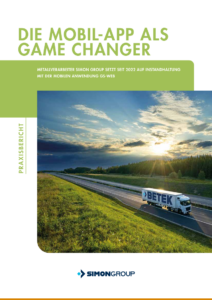
Download the Simon Group customer success story as a PDF here. If you have any further questions, feel free to get in touch. We look forward to hearing from you.
Whether you have to master similar tasks in your company or face other challenges: check whether GreenGate software can help you. Here you will find related Blueprints that can handle maintenance tasks and solve problems.
That’s why so many companies trust us.


If you have further questions about this case, please call us or fill out the form here. We will get back to you promptly.