Instandhaltungssoftware für Industrie, Versorger und Windkraft
Reference Customer | Case Study
Safety is a state of being. Essentially, it’s just a snapshot in time. That’s precisely why safety-critical factors in industry must be regularly reviewed, documented, and kept up to date. Nowhere is this understood better than in the heart of the Rhine-Neckar metropolitan region: Here in the greater Mannheim area, where the chemical and pharmaceutical industries dominate the industrial landscape, Gesellschaft für die Verwertung von Sonderabfällen mbH & Co. KG (G.V.S.) has been addressing safety issues for over 40 years as part of its business portfolio.
G.V.S. was founded in 1979, employs 25 people, and generated revenue of EUR 17 million in 2019. Since 2017, the company has been using GreenGate’s GS-Service operations management software primarily as a safeguard to ensure the legally compliant safety of people and machinery. In this interview, G.V.S. Managing Director Jens Paßmann explains the reasons behind this implementation and outlines his experiences with the software.
Gesellschaft für die Verwertung von Sonderabfällen mbH & Co. KG (G.V.S.) uses GS-Service as a central platform for the legally compliant management of facility infrastructure, operating resources, and personnel. Particular emphasis is placed on safety and certification management, as the disposal and treatment of hazardous waste require special environmental, social, and economic care and are subject to strict legal requirements.
GS-Service – GS-Manager
Digital inventory and recording of all equipment, assets, and employee data in GS-Service; analysis of existing operational processes and identification of opportunities for optimization; integration of a custom G.V.S.-specific solution for personnel and certificate management; dynamic deadline monitoring and notification system for certificates and inspections due.
Using the GS-Service operations management software, Gesellschaft für die Verwertung von Sonderabfällen mbH & Co. KG in Mannheim monitors and manages the certificates and authorizations of its employees and external service providers.
The status of facilities and equipment, as well as upcoming and completed maintenance activities, are also documented in a legally compliant manner.
What was the initial reaction to documenting employee qualifications, facilities, and equipment in a professional system like GS-Service?
Paßmann: The RP was thrilled. His exact words during the first incident response inspection after the data was entered into GS-Service: “That’s great.” In our business, the tolerance threshold is extremely low; so external stakeholders are grateful when, in addition to the functionality and maintenance status of the equipment, employee certifications are also digitally documented.
You operate a tank farm in Mannheim (7,000 m³) and specialize in the storage and treatment of solvent-containing and aqueous wastes. To be specific: What makes this so dangerous?
Paßmann: Due to the nature of the materials, everything is hazardous: the storage, handling, and transport of the waste. This is because each type of waste typically meets at least one of the 15 hazard criteria, such as flammable, corrosive, carcinogenic, etc. That is why we also invest a great deal of time and effort in quality assurance.
GS-Service has been an integral part of this QS strategy since 2017. In what ways?
Paßmann: It enables us to fulfill our duty of care and documentation. As a certified waste management company, we must first and foremost meet the standards set forth in the Circular Economy Act and the Waste Management Companies Ordinance. Furthermore, we must provide certifications and documentation regarding the handling of hazardous waste by ship, the Major Accidents Ordinance, ISO 9001:2015, etc., as well as meet customer-specific requirements. The relevant information is consistently and up-to-date stored in GS-Service. We regularly refer to this information during operational inspections, safety reports, as well as audits and site visits with external parties such as customers, expert organizations, and industry associations.
What information is available in GS-Service?
Paßmann: As the facility operator, we are obligated to ensure operational safety. That’s why, for example, information on the functionality and maintenance status of the infrastructure is entered into the system—but first and foremost, the infrastructure itself is digitally mapped. This includes, among other things, the tank farms, the piping system (including valves and gate valves), the safety equipment for explosion and fire protection, and the office and laboratory building with its emergency facilities.

Dipl.-Ing. Jens Paßmann
Managing Director of Gesellschaft für die Verwertung von Sonderabfällen mbH & Co. KG
Using the GS-Service operations management software, Gesellschaft für die Verwertung von Sonderabfällen mbH & Co. KG in Mannheim monitors and manages the certificates and authorizations of its employees and external service providers.
The status of facilities and equipment, as well as upcoming and completed maintenance activities, are also documented in a legally compliant manner.
What needs to be maintained at G.V.S., and what kind of operational management system is required?
Paßmann: It starts with the transshipment terminal for tankers, the two rail spurs, and the loading platforms for road tankers. This includes, for example, pressure testing the hoses used for loading and unloading. Of course, this also applies to stationary fire suppression systems, fall protection, explosion-proof equipment, catch basins for all tanks, double-floor systems with vacuum monitoring and sunshades, or overfill protection for the tanks, and so on. By the way, in GS-Service we also manage the laboratory equipment, including information on calibration, verification, and the corresponding test data.
The facilities are one thing; the people who operate them and their occupational safety are another. Especially for safety-critical environments, such as those operated by G.V.S., GS-Service offers solutions for permit management and information management related to medical fitness.
Paßmann: We handle this under “Certificate Management.” We primarily employ specialists in the individual waste management departments. They must have the appropriate qualifications and be physically capable of performing their duties—the same applies to third-party service providers. We can track the certificates and authorizations for employees and external personnel in GS-Service in compliance with all data protection regulations.
How does this work in practice?
Paßmann: The system checks whether an upcoming certification date falls in the past or the future. If it is coming up soon, the system creates a task via the PermitPlugin and notifies the user of the need to certify the employee. If the due date has already passed, access to the company premises can be denied.
You’ve already mentioned the laboratory work at G.V.S.—why do you maintain your own in-house laboratory?
Paßmann: Every shipment is tested and analyzed in the laboratory before it is accepted. This ensures that only approved substances are accepted and that occupational safety and plant safety requirements are taken into account. Based on this, we design solutions for disposal that are both environmentally sound and cost-effective—whether through our own facility or through the facilities of our partners, that is, waste disposal companies that we arrange as brokers.
What is the end result of the treatment process?
Paßmann: Either the recovery of solvents, energy recovery in industrial combustion plants, material recycling, or disposal in hazardous waste incineration facilities. Incidentally, we also continuously monitor our tank storage inventories and conduct a final analysis of every single outgoing shipment.
The Rhine-Neckar region is considered a hotspot for the chemical industry. Does that answer the question about your clientele?
Paßmann: Waste disposal on behalf of the chemical industry accounts for approximately 60% of our revenue. We also serve 38 other industrial sectors, including metallurgy, pharmaceuticals, plastics processing, automotive, surface treatment, electroplating, and even the military.
Where does G.V.S. operate?
Paßmann: We serve clients in the D.A.CH. region—Germany, Austria, and Switzerland—as both a broker and a waste disposal provider, as well as in Benelux, France, and Italy.
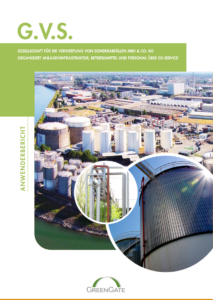
Download the G.V.S customer case study as a PDF here. If you have any further questions, please feel free to contact us. We look forward to hearing from you.
Whether you have to master similar tasks in your company or face other challenges: check whether GreenGate software can help you. Here you will find related Blueprints that can handle maintenance tasks and solve problems.
That’s why so many companies trust us.


If you have further questions about this case, please call us or fill out the form here. We will get back to you promptly.