
Instandhaltungssoftware für Industrie, Versorger und Windkraft
Reference Customer | Case Study
Many manufacturing companies are quick to claim they are undergoing a “paradigm shift.” However, anyone who takes a look at the structurally reorganized maintenance department at the BILSTEIN GROUP will indeed see a significant transformation. By consolidating maintenance operations for all three production facilities in Hohenlimburg, the company has created a systematically restructured workflow that promises success in terms of both efficiency and quality. The unifying element of this new structure is the GS-Service operations management and maintenance system from GreenGate AG.
GS-Service
Consolidation of the maintenance organization across the three plants and implementation of a centralized planning system using GS-Service. Establishment of a plant object structure to provide a detailed representation of machinery and equipment, as well as the integration of cost-related data such as maintenance labor costs; pilot implementation on one plant in 2010, followed by full-scale launch in 2011 and gradual expansion of use to other areas such as plant and process engineering, production, technical purchasing, and warehousing
Since the beginning of 2011, the Plant and Process Engineering (AT) division of BILSTEIN SERVICE GmbH has been responsible for maintenance (AT-I) in addition to its existing core departments of project management, design, building services engineering, and occupational safety. “With this consolidation, we are pooling maintenance expertise for all our facilities,” says Managing Director Dr.-Ing. Rolf Jansen, explaining the restructuring. BILSTEIN, HUGO VOGELSANG, and C. VOGELSANG are thus not only increasing the technical availability of their equipment but also benefiting from numerous additional synergies that improve the quality of maintenance activities while simultaneously reducing costs.
A key component of the concept is the standardized management of spare parts and inventory. To this end, the three existing warehouses have been organizationally consolidated. This allows inventory to be efficiently utilized and managed on an ongoing basis. Furthermore, the expertise from the three locations is pooled through cross-functional teams. This has resulted in teams of specialists with specific qualifications in areas such as hydraulics, pneumatics, and programming, which the companies of the BILSTEIN GROUP can now draw upon as needed. “Centralization ensures transparent and standardized information structures and processes. Maintenance serves as a service provider for the entire production of our corporate group,” explains Dr. Jansen.
Employees organize work planning, including order management, through a centralized planning system. All companies jointly use GreenGate AG’s GS-Service maintenance system for this purpose. “The new software allows for the efficient and rapid organization of operational and maintenance processes. Malfunctions, damage, and weak points are systematically analyzed and help to significantly increase equipment availability,” according to the BILSTEIN GROUP. GS-Service also serves as an information platform for the technical documentation of machines and equipment.
It provides a continuous overview of all inventory and spare parts stocks, as well as key metrics such as orders, damage, malfunctions, costs, and working hours.
Whether you have to master similar tasks in your company or face other challenges: check whether GreenGate software can help you. Here you will find related Blueprints that can handle maintenance tasks and solve problems.

Dipl.-Ing. Helmut Mühlnickel is an authorized signatory of the Bilstein Group, where he is responsible for centralized maintenance (AT-I) at the three BILSTEIN manufacturing facilities.
In this interview, Helmut Mühlnickel discusses the background of the implementation, as well as the features and benefits of the GS-Service maintenance system.
Helmut Mühlnickel: With the centralization of maintenance across three plants and their organization under a single management structure, we needed a software tool that would effectively support the elimination of siloed systems. Moreover, since maintenance was effectively integrated into operations, it was also important to increase cost transparency.
Helmut Mühlnickel: Yes, absolutely. Especially since GS-Service also makes it possible to optimally plan repair shifts, document the reasons for equipment downtime, and centrally document maintenance-related information.
Helmut Mühlnickel: Among other things. Because by introducing a standardized IPS across the three plants, we were also able to make our spare parts inventory transparent. GS-Service improves the overall quality of maintenance.
Helmut Mühlnickel: After its initial implementation in maintenance in January 2011, GS-Service was gradually rolled out in the areas of plant and process engineering, production, technical purchasing, and warehouses.
Helmut Mühlnickel: Our employees consider GS-Service to be a flexible program. One particularly positive aspect is that GreenGate is always approachable and genuinely committed to meeting individual needs. This was already evident during the test setup on a relevant system in 2010 and during the full-scale launch in 2011, which included creating a system object structure down to the level of cost relevance, recording maintenance labor costs, and continuing to build out the object tree structure.
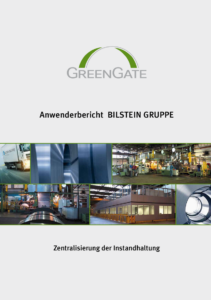
Download the Bilstein customer case study as a PDF here. If you have any further questions, please feel free to contact us. We look forward to hearing from you.
That’s why so many companies trust us.


If you have further questions about this case, please call us or fill out the form here. We will get back to you promptly.