
Instandhaltungssoftware für Industrie, Versorger und Windkraft
Reference Customer | Case Study
If time really is money, plant availability at the Armacell site in Münster becomes the number one priority.
As the linchpin of a global value chain comprising 25 production sites across 17 countries, a breakdown in Münster would result in significant costs arising from downtime. This is because the European headquarters of the leading manufacturer of flexible insulation materials supplies at least all European plants with masterbatches, amongst other things. Reason enough to leave no stone unturned in production as part of the ‘World Class Armacell Mindset’ initiative. And lo and behold: since the GS-Service operational management system has been managing maintenance and spare parts stock, things that were already going well are now running even more smoothly.
The challenges are as great as the plants themselves: that is why Armacell, the world’s leading manufacturer of flexible insulation materials for plant insulation, relies on GS-Service. At its production site in Münster, the company uses the GreenGate software as the digital engine and manager for maintenance, fault management and stock control.
GS-Service – GS-Manager, GS-Mobile
Digital recording of plant infrastructure, equipment, spare parts and staff in GS-Service; stock-taking, analysis, optimisation and documentation of all processes; pilot implementation, training, go-live
The in-house supply chain, with its distinctive technical and organisational interlinking of systems, is one thing. Increased demands for productivity and environmental protection are another. At Armacell, the two are inextricably linked and identify the production lines, in particular, as the critical point: “Prolonged downtime is unacceptable,” says Lennert Wiels, Maintenance Manager at the Münster plant. “If, for example, there are problems or faults with the exhaust gas after-treatment system, the relevant production lines in the manufacturing area immediately come to a standstill.” What can be done? “Preventive maintenance is certainly the right and important approach here.”
GS-Service has been in use at Armacell Münster since the end of 2015. The two production lines critical to the system are monitored remotely from the workshop area, and the checks are in turn documented in GS-Service. This applies to virtually everything relating to day-to-day operations in plant engineering, infrastructure, utilities supply, the central warehouse, R&D and facilities in Münster. And when you document things, you’re also basing your planning on a consistent set of data: “We make full use of this capability in GS-Service,” explains Lennert Wiels, “it’s a necessity of the moment, not least because we’ve now reached a critical size as a company – as evidenced by our order book.”

Lennard Wiels, Maintenance Manager
Essentially, GreenGate’s GS-Service – as a system subordinate to the ERP – integrates planning, documentation and monitoring functions, as well as business management applications, into a single information and management system. The object-oriented software – designed as a scalable client/server solution – is based on standard technology and runs on the latest Microsoft operating systems. One advantage is that, thanks to its open system architecture, GS-Service can be integrated with other systems such as Armacell’s SAP ERP. GS-Service was introduced in 2015 to replace the industry-wide patchwork of solutions comprising Excel, in-house programmes, freeware and paper-based filing systems. However, this was not a ‘big bang’ implementation. Lennert Wiels recalls the agile approach, moving from the broad strokes to the finer details: “When we introduced GS-Service, the maintenance staff weren’t exactly thrilled. But that’s exactly what we’d expected! That’s why we first presented the system in detail, gathered feedback and got the system up and running in a rudimentary form – without going into too much detail. The processes were described step by step in training materials and presented in PowerPoint. That worked very well for us. As a result, GS-Service became second nature to our colleagues.”
The 35 colleagues in the maintenance department have come to really appreciate the IT-supported maintenance routines. Take shift handover, for example, which takes place 17 times a week. “The handover is brief,” says Wiels, “but everything is clearly documented in the shift report from GS-Service.” In GS-Service, maintenance orders are not only pre-scheduled; maintenance staff also receive specific operating and maintenance instructions complete with checklists. “The pool of tasks is therefore clear, and the team can organise their own shift. This high degree of personal responsibility has proved its worth.” GS-Service also stores photographic documentation of inspections and measurement data for the systems; from 2020/21 onwards, this will be done via the GS-Mobile module.
Lennard Wiels
Keyword: Controlling. Armacell recorded a verifiable boost in efficiency through the use of GS-Service for spare parts management. “We now estimate the savings in tied-up capital at around 80,000 euros – roughly 15 per cent of the stock volume,” says Wiels, “and expect much more once all consumption figures are available.” The principle behind this new efficiency is easily explained. Previously, stock-managed items in SAP were purchased, stored and recorded in Excel based on empirical data. “However, we didn’t really know where the critical components were,” says Wiels. Thanks to feedback from maintenance data and information on plant performance, it is becoming increasingly clear when which spare part – in other words, what stock volume – is actually required. “Accordingly, we have defined stock levels and entered order times in GS-Service based on minimum-maximum stock management. The system reports the stock levels. In future, stock reconciliation and orders are to be carried out automatically via an interface to SAP ERP, possibly as early as 2020.”
“Colleagues are certainly enthusiastic”
The intelligent workflow with GS-Service has also sparked interest at other Armacell sites: “Of course, we exchange ideas with maintenance staff from other countries. Our colleagues from Poland and England were really impressed by GS-Service, particularly because it improves communication and identifies critical issues,” confirms Lennert Wiels, who gives the provider and the software high marks: “Apart from the balanced package of price and performance, preliminary discussions and references, it naturally suits us that we were given a free hand with the system’s structure. GS-Service is flexibly customisable and user-friendly. The contacts at GreenGate are also quick to assist with timelines, budgets or proposed solutions via TeamViewer. It simply works.”
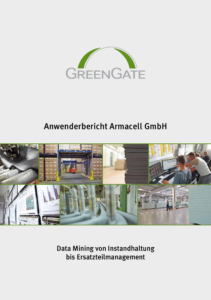
Download the Armacell customer case study as a PDF here. If you have any further questions, please feel free to contact us. We look forward to hearing from you.
That’s why so many companies trust us.



Whether you have to master similar tasks in your company or face other challenges: check whether GreenGate software can help you. Here you will find related Blueprints that can handle maintenance tasks and solve problems.
If you have further questions about this case, please call us or fill out the form here. We will get back to you promptly.