
Instandhaltungssoftware für Industrie, Versorger und Windkraft
Reference Customer | Case Study
How can deployment planning in the utilities sector be optimized without relying on professional workforce management? The answer is simple: it can’t. After all, anyone who wants to dispatch the right resource at the right time, according to the job at hand, has to keep everything in view: the workload and qualifications of field service staff, the materials they’re carrying and fixed appointments, as well as spontaneous customer inquiries or incident handling. This only works in real time — and therefore only digitally. There are, of course, options.
However, everything from morning job assignment by the foreman and the analog clipboard alternative to manual data entry leads to exactly what no modern utility company can afford anymore: inefficiencies and poor customer service. That’s why Rhein-Sieg Netz GmbH and Westerwald-Netz GmbH, subsidiaries of rhenag Rheinische Energie Aktiengesellschaft, rely on workforce management with GS-Service, known as the GS-Manager.
Rhein-Sieg Netz GmbH (RSN) and Westerwald-Netz GmbH (WWN) use GS-Service as their central workforce management system to efficiently manage field service assignments, material requirements, route planning and customer orders. Mobile devices enable real-time documentation directly on site at the customer’s premises.
GS-Service – GS-Manager – GS-Touch – Interfaces to: GIS systems + the lima business management system
Optimisation of resource planning, taking into account qualifications, availability, travel times and materials
• Reduction in manual, error-prone paper-based processes
• Real-time visibility for dispatchers and foremen regarding order status, defects and work completed
• Standardisation of order follow-up across multiple sites
• Integration of scheduled and ad hoc orders, fault management and routine plant maintenance
Analysis and harmonisation of site processes; introduction of GS-Manager, including a scheduling module with an optimisation algorithm for route and team planning; equipping fitters with GS-Touch on smartphones/tablets; integration of interfaces with GIS and back-office systems (lima); training for dispatchers, foremen and fitters; integration of external service providers via pre-configured mobile devices
Are the next recurring tasks in the business system due? Is the smart meter roll-out under the Metering Point Operations Act breathing down your neck? As well as managing your own resources, do you also need to coordinate external service providers? “Together with our client, we addressed these questions back in 2015,” explains Martina Hundhausen, IT Project Manager at GreenGate, “our GS Manager presented itself as the solution because it fully covers the planning, documentation and organisational functions required by network operators.”
The network companies Rhein-Sieg Netz GmbH (RSN) and Westerwald-Netz GmbH (WWN) are subsidiaries of rhenag, Rheinische Energie Aktiengesellschaft. rhenag is a regional energy supplier and a nationwide cooperation partner for municipal utilities, based in Cologne. Specifically, in 2014, the agenda focused on optimising operational and administrative activities at the network companies. “Moving away from error-prone paper-based processes,” says Jochen Günter, Head of Networks at Rhein-Sieg Netz GmbH, outlining the overarching goal, “our aim was to prepare and manage maintenance activities centrally via a fully digitalised scheduling system. We also wanted to minimise manual data entry into the database – all without transposed digits or lost slips of paper.” The GS Manager went live as early as February 2016, initially “with a focus on the mass process – the inspection cycle for meters and control devices”, says Günter, “whilst the harmonisation of operational sites through standardised processes and route optimisation were key priorities.”
In accordance with the network operators’ scheduling strategy, all customers are contacted in advance with a proposed appointment. This process is initiated by exporting the planned appointments, together with data relating to the scheduling order, to a software programme for generating letters. Alternatively, a mail merge function is available in GS-Manager. When customers respond, the appointments are rescheduled by the dispatch department. Speaking of scheduling: it plays a key role in the transition from stand-alone solutions to centralised management of field service operations at Rhein-Sieg Netz and Westerwald-Netz. Using the GS-Scheduling module, the department – which has now been expanded from two to four staff members – plans the orders in advance.
Martina Hundhausen: “The optimisation algorithm ensures that journey times are minimised, whilst taking into account working hours, downtime and staff qualifications.” Orders from a particular district are, for example, allocated to the required team of staff – 20 to 30 fitters are always on the road in the catchment area between the Rhine railway line and the A45. “Geographical clustering has already proved its worth,” says Bernhard Lagermann, operations manager at Rhein-Sieg Netz, “and route optimisation without empty runs means improved efficiency in job processing. The vast majority of foremen and staff wouldn’t want to be without this system now.”

To carry out their jobs, fitters have access to the GS-Touch app on their company smartphones. The app lists scheduled jobs with their due dates in a calendar on a day-by-day basis. “The smartphone is the ideal device,” says Peter Krupp from the Information Systems department at Rhein-Sieg Netz GmbH, “our colleagues out in the field are very happy with the workflow, including on-site jobs with email integration and photography.” To support scheduling, jobs can be visualised on maps in Google Maps. Particularly in the case of remaining tasks, the map functions can be used to put together sensible job bundles, enabling the team to tackle cross-district jobs as well. Where necessary, supplementary tasks such as valve inspections are added to the job list. “A major advantage,” says Jochen Günter, “is that colleagues can select jobs from the pool, concentrate on the actual work and do not have to worry about organising their work.” This also brings the planning process closer to the actual execution of the jobs.
Data from the GIS system is used to determine the location of jobs. The GS Manager regularly imports all towns, streets and house numbers for the network areas via an interface and maps them. In addition to the coordinates, data such as maintenance districts is also transferred. “Navigation via mobile devices offers significant added value, particularly for external service providers,” says Peter Krupp. “Although the service providers are not directly scheduled, they are provided with pre-configured devices containing packages for job processing.
The process for feeding the job data back into the GS system via smartphone is then the same as for internal staff.” The actual meters, regulators and service connections associated with the house numbers are transferred from the business management system ‘lima’ – a system developed in-house by rhenag and now in use by utility providers nationwide – via a separate interface, depending on the task at hand (meter reading, replacement). The assignment is made using the details of the supply point linked to the house number.
At the customer’s request, jobs such as replacing a gas meter or inspecting the gas service connection are grouped together in the GS system by supply point. The grouping is carried out by job type: electricity or gas/water. “It makes a better impression on the customer anyway if we only visit the site once a year,” says Bernhard Lagermann. The necessary qualifications, such as ‘Gas Technician’, can be stored in GSManager alongside the potential jobs, as can the planned duration for each job type.
Optimal work planning also – and in particular – covers equipment and material requirements: using an additional, user-specific function, the replacement equipment required from the jobs can be totalled to ensure the vehicles are loaded as efficiently as possible.
Whether you have to master similar tasks in your company or face other challenges: check whether GreenGate software can help you. Here you will find related Blueprints that can handle maintenance tasks and solve problems.
Currently still using a Samsung Galaxy running on Android, but soon to be using only Apple devices (iOS), the era of digital mobility is arriving right at the customer’s doorstep. In the GS-Touch app, you can view pre-stored master data or directly enter new data such as meter readings and photos for documentation purposes. In particular, the pixolus module is used here to capture meter readings via the camera. The meter reading is extracted from the photo and automatically entered into the GS system.
Similarly, scanning functions can be used, for example, to record a newly installed meter. Peter Krupp: “We designed the smartphone app in collaboration with Green-Gate so that fitters can use it easily and intuitively.” And they actually do so, meaning that the media breaks of the past are just as much a thing of the past as the use of different document templates, etc.: “The major advantage lies in the post-processing stage,” adds Jochen Günter, “our fitters work directly within the system; nothing needs to be reprocessed here. The control functions governing access to stored data are also a positive feature.” Once the completed jobs have been exported back to the GS-Manager – where they can also be saved as PDFs for archiving – the data, together with the photos of the meter readings, is exported to lima for commercial billing.
Just like the scheduling department, the foreman can view and assess outstanding orders and recorded defects, and respond accordingly. “As the GS system allows for the use of standardised document templates, follow-up processes are carried out consistently across different sites.”

From left to right: Peter Krupp, Information Systems Department, Rhein-Sieg Netz GmbH; Bernhard Lagermann, Site Manager, Rhein-Sieg Netz GmbH; Jochen Günter, Head of Networks, Rhein-Sieg Netz GmbH
Rhein-Sieg Netz and Westerwald-Netz are currently set to further expand their digital processes using the GS system. Bernhard Lagermann: “We want to manage both planned and ad hoc measures via the system.” In practical terms, this means that fault reporting will henceforth be handled via the GS Manager, as will the maintenance of control systems – Peter Krupp: “Specifically, we’re talking about 2,000 items that need to be checked regularly, ranging from fire hydrants and generator sets to cordless drills and ladders.” Time recording for the various jobs is also to be handled via the GS system in future and transferred to rhenag’s job order management system. Can this be implemented within a reasonable timeframe? “After all,” says Bernhard Lagermann, “when we introduced the GS Manager, we managed to develop a roll-out-ready product within a year – that was quick.”
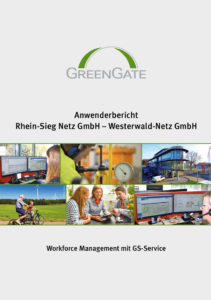
Download the Rhein Sieg Netz customer case study as a PDF here. If you have any further questions, please feel free to contact us. We look forward to hearing from you.
That’s why so many companies trust us.



If you have further questions about this case, please call us or fill out the form here. We will get back to you promptly.