
Instandhaltungssoftware für Industrie, Versorger und Windkraft
Reference Customer | Case Study
FORD Transmissions GmbH in Cologne uses GS-Service to digitally organise its maintenance and spare parts management. The aim is to transition from reactive to preventive maintenance, to optimise material and spare parts stocks, and to increase efficiency in gearbox production. The software supports over 650 users in the planning, documentation, management and monitoring of all maintenance processes
GS-Service – GS-Manager; GS-Web; GS-Permit; GS-ManagementCockpit-Megamatenentnahme; GS-Events; GS-WarehouseClient
Introduction of GS-Service from 2007 onwards in several pilot projects, initially covering sub-areas (150 and 300 machines), followed by a full roll-out at the Cologne site; Digitisation of maintenance processes, including materials and spare parts management; mobile integration via GS-Web and tablets; training for maintenance and production staff; establishment of standardised key performance indicators and reporting processes; gradual expansion to other plant areas and integration of quality and measuring equipment management
Every company has critical assets – these have a direct and significant impact on the performance and profitability of, for example, production and distribution. High machine availability combined with a low total cost of ownership is therefore the ultimate goal. Consequently, in 2005, the gearbox manufacturer FORD, based in Cologne – which employs 188 staff in maintenance alone, accounting for just under 15 per cent of its total workforce – commissioned a management consultancy to analyse its maintenance operations. Until then, there had been neither key performance indicators nor any other benchmarks available for preventive maintenance with transparent, cost-effective operational processes.
After six months, the optimisation plan – designed to lead to success in five steps – was finalised. The experts identified the implementation of maintenance software as the key issue and subsequently surveyed the market. In doing so, they drew on a report by the Fraunhofer Institute on maintenance software in terms of costs and service. GreenGate AG was awarded the contract on the basis of the compelling value for money offered by its GS-Service operational management system. Things then moved quickly: in February 2007, the first pilot project was launched, in which a cost centre – comprising around 150 machine units – was managed entirely via GS-Service.
In April 2007, the second pilot project was launched, incorporating a further 300 machine units. On 1 May 2007, FORD Werke GmbH switched entirely to the GreenGate solution. “Since then, the maintenance data for all 3,600 machine units has been recorded, documented and processed via GS-Service,” said Hans-Günther Hensengerth, Head of Maintenance at FORD Werke GmbH, Cologne plant.

As a system subordinate to the ERP, GS-Service integrates planning, documentation and monitoring functions, as well as business management applications, into a single information and management system. The object-oriented software – designed as a scalable client/server solution – is based on standard technology and runs on the latest Microsoft operating systems. A key advantage is that, thanks to its open system architecture, GS-Service can be integrated with other systems (GIS, ERP). It is also easy to use mobile devices or a ‘digital pen’ for order processing.
Whether you have to master similar tasks in your company or face other challenges: check whether GreenGate software can help you. Here you will find related Blueprints that can handle maintenance tasks and solve problems.
At FORD, all employees involved have access to GS-Service, since everyone has to enter their own work orders and data. Hans-Günther Hensengerth: “The fact that maintenance technicians understood within 15 minutes during the rollout how to operate the software and write up work orders is due to the entire maintenance system running under a familiar Windows interface.” Storing photos is also simple and straightforward. Ferdinand Pick, Maintenance System Coordinator, FORD Werke GmbH, Cologne plant: “What good is the best system if it’s complicated to use and therefore doesn’t get used? After all, maintenance technicians don’t want to waste time in front of the PC.”
GS-Service is more than a digital chronicler of equipment. Now established as an electronic inspection log, duly audited and approved by Ford, the individual machine findings stored as documents/reports form the basis for proactive maintenance. GS-Service flags when and to what extent certain deadlines, tasks or procedures need to be met or completed. But the system offers the user more than simply calculating, based on elapsed time, when a particular machine part needs servicing. GS-Service generates reports that are used at different time intervals. For example, the MTTR (Mean Time To Repair) report forms the basis of discussion in every weekly meeting. Hans-Günther Hensengerth explains: “All production areas can compare their own machines internally, as well as machines from other segments externally. Together with the MTBF (Mean Time Between Failures) report, these are the department’s most important metrics, discussed in detail in our weekly meetings with production managers.”
This creates win-win situations for everyone involved. After all, preventive maintenance benefits essentially from knowledge about operation, servicing, and also past incidents. Based on the consistent documentation in GS-Service, GETRAG FORD Transmissions can likewise check verifiable facts to determine whether equipment availability has improved. Depending on the perspective and question at hand, the system provides meaningful analyses for individual plants and machines that incur more or less cost, in some cases also for different individual production processes. The documentation, which in 2009 resulted in the creation of a maintenance brochure used as a benchmark for other plants within the company, continues to serve as a sound basis for decision-making. Hans-Günther Hensengerth: “Whether for department-internal measures to improve workflow, or for upcoming investments — as evidence of their necessity — in dialogue with the plant manager and the controlling department.”
What FORD saw as a positive from the outset later proved to be a stroke of luck: the extreme flexibility and scalability of GS-Service. “Whilst searching for a compatible system for spare parts management, we checked with GreenGate to see whether GS-Service could be expanded accordingly,” said Hans-Günther Hensengerth. In fact, GETRAG FORD Transmissions was able to implement spare parts management in GS-Service, including comprehensive documentation of the newly established central main warehouse, with details of all spare parts, including their storage location, photographs and stock levels. Ferdinand Pick adds: “Top marks for delivery, order accuracy and service, as well as the availability of critical machinery, are key factors for success.”
Just as FORD Werke GmbH responds dynamically to changes in the market in terms of products and solutions, so too is GS-Service designed to be flexible and is continually adapted to new in-house requirements. Ferdinand Pick: “Even though our exchanges with GreenGate were more intensive during the roll-out and pilot phases, with weekly meetings, and have now been reduced to half-yearly meetings, we can still speak of a very close dialogue today. We are currently working together on the possibilities of mobile solutions using a PDA.” Hans-Günther Hensengerth: “Using a PDA, all the necessary documentation and reports would be accessible on site at the machines.” Interactivity included: “Ideally, a machine would independently provide us with information about a problem or an impending event – via text message to the PDA of the relevant staff member. That is our goal.”

The need for optimised spare parts management was obvious. Travel times and waiting times were simply too high – these are referred to as ‘non-value-adding activities’. Aspects such as duplicate stocking due to a lack of knowledge, or the procurement of spare parts as an emergency measure when it was not strictly necessary, also proved to be uneconomical, as many existing spare parts could not be located. Hans-Günther Hensengerth: “We also identified as an untenable situation the fact that there were many disorganised storage locations containing unknown parts, which, on top of that, were not known to every employee.”
Long repair times, as well as machine and production downtime caused by the time-consuming search for spare parts, have been a thing of the past since the entire stock was recorded in GS-Service. What’s more, thanks to the recording in GS-Service, stock levels have been reduced by 30 per cent through volume optimisation, which corresponds to a one-off cost saving in the six-figure euro range.
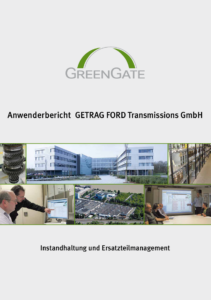
Download the Ford customer case study as a PDF here. If you have any further questions, please feel free to contact us. We look forward to hearing from you.
That’s why so many companies trust us.



If you have further questions about this case, please call us or fill out the form here. We will get back to you promptly.