Instandhaltungssoftware für Industrie, Versorger und Windkraft
Reference Customer | Case Study
Digital cockpit for disaster response: Energienetze Mittelrhein rebuilds the gas supply in the devastated Ahr Valley in record time – GreenGate AG’s Workforce Management System, combined with QGIS, supported dispatching, field technicians, and decision-makers.
The flash flood in the Ahr Valley, triggered by extreme heavy rainfall on 14 and 15 July 2021, claimed 134 lives and also destroyed large parts of the natural gas network. Once the floodwaters receded, the full extent of the damage became apparent: 133 km of destroyed or damaged gas pipelines, 14 damaged or destroyed gas pressure regulating stations, eleven destroyed Ahr river crossings, and thousands of affected service connections. Just one day after the flood, it was already clear that reconstruction would be a race against time – specifically against the onset of winter 2021/22.
A major task lay in the hands of Energieversorgung Mittelrhein (evm). It is the largest energy and services company from Rhineland-Palatinate and, through its network subsidiary Energienetze Mittelrhein (enm), is responsible for gas supply in the Ahr Valley. The timeline was met: by winter, nearly all consumers were reconnected to the gas network.
GS-Service – GS-Manager, GS-Touch, GS-Web-QGIS**
Digitally recorded infrastructure, equipment, spare parts, and personnel matched in the GS system using QGIS; contract staff continuously trained in the use of GS-Touch; tablets accessible via identity card issued to two-person teams; documentation of completed tasks/damages/defects while on the move; results-based dispatching during ongoing operations.
enm was able to fully restore the natural gas supply in the Ahr Valley within 5 months, in time for the start of the heating season.

In this interview, Martin Friedrich, Team Leader Workforce Management in the Technical Information Systems department at enm, outlines the solutions implemented and describes the role of IT in restoring the gas supply in the particularly hard-hit lower Ahr Valley.
From the perspective of the network operator: What was an early indication of the scale of the disaster?
Martin Friedrich: Water and mud ingress, along with entire pipeline sections being washed away by the flood, resulted in significant gas losses in the affected area on the night of the disaster. Since it was no longer possible to determine where gas was escaping from the pipeline in a controlled manner and where it was escaping uncontrolled, the valves were shut off. This shutdown caused the pressure in the pipeline to drop, allowing additional water to enter the gas pipelines—and in some cases, via heating boilers that were submerged, into household connections as well.
What was your core task in the weeks and months following July 15, 2021?
In addition to rebuilding the pipeline network, our focus was on restoring the gas connections in residential, commercial, and industrial areas to operational condition. This involves decommissioning the connections, repair or modification, and recommissioning. We are responsible for making gas available again as quickly as possible. The heating system itself then falls within the customer’s area of responsibility.
What do you do on day 1 after the flood?
Staff were called in from various locations. First, we assessed all the external damage – above all to the local pipeline network. Work on decommissioning the connections in the houses began quickly. Before supply can be resumed, all gas connections first have to be shut off. In the lower Ahr valley, we’re talking about more than 7,000 connections. Every house has to be visited, the valve closed and sealed, so that pressure can be put back on the line once it’s operational again.
Over 7,000 gas connections to be inspected in the lower Ahr Valley: what parameters were used to prioritize this work?
For decommissioning, prioritization was not necessary. Here, we could only work on areas as access became possible. Much of the area was so badly destroyed that there was initially no access at all. For recommissioning, on the other hand, we based our approach on the pipe network and on which areas could be brought back into operation fastest with the least effort.
When life and limb are in immediate danger, proper documentation of shutdowns takes a back seat. However, the situation in the lower Ahr Valley after July 15, 2021, was different: the flood, and with it the immediate danger to life, was gone, but the destruction was just as real as the almost incomprehensible mass of tasks that had to be completed quickly, safely, and in a logical sequence before winter. How did you approach this?
At the beginning, we tried to orient ourselves using the paper-based plans, marking where we were as we carried out the shutdowns. However, this approach quickly reached its limits, as the number of connections and the number of employees deployed were so large that it became difficult to keep an overview. There were simply a great many tasks that had to be coordinated easily and promptly.
What conclusions did you draw from this – after all, the clock kept ticking?
To get the situation under control quickly, we decided on a truly solid combination of a geographic information system and the GS-Service operations management system. Over many years of day-to-day business, this has proven itself well in scheduling, maintenance, and documentation of our repair and maintenance work. Even though in everyday operations we often work with an object tree structured hierarchically by municipality, street, and house number, we opted for the map-based option: water doesn’t know streets – it simply goes wherever it wants to go.

How should this combination of GIS and workforce management be envisioned?
First, we overlaid the flood area with a clustering and divided the “Bad Neuenahr – Ahrweiler” area into zones or sectors, so that everyone knew what was being referred to. The whole thing was visualized using QGIS maps – this already allowed dispatch to work very effectively, as the map precisely displayed the pressure zones, the individual assets, and their processing status. We were also able to filter out the flooded connections, since spatial overlay analysis allowed us to identify the house connections located within the flood area. The GIS was fed with up-to-date data from GS-Service. From this visualization, dispatchers could see who was working where and when.
Speaking of which: how were the technicians supplied with the right information?
Through synchronization of the work orders in the mobile app on the tablet. Our own staff was already equipped, while external helpers were equipped as part of a briefing at the start of their assignment. This also made it possible for everyone to start directly without having to meet centrally in the morning. With an availability of 70 additional tablets that we had prepared for the deployment, we had a maximum of 45 devices in use at any one time, meaning 90 people out in the field. The app on the tablet is GS-Touch, the mobile solution of our workforce management system GS-Service. GS-Touch covers standard workflows for tasks, activities, and events. In addition to a map, the application also provides a daily overview of tasks. This allows users to record defects, take photos, and report completed tasks from the field. The information is synchronized with the database either continuously or after the shift.
How did the information from the field get back to coordination at the operations center as quickly as possible? How did the dispatchers and technicians communicate?
When the technicians in the field needed new tasks, they called dispatch. The dispatchers, in turn, marked and filtered via the system, assigned tasks by selecting the work package and entering the name, and saved everything. This completed the task assignment, which then appeared on the tablet on site – this worked extremely well both for decommissioning and for recommissioning. To put it a bit more vividly: the dispatchers assign tasks to the tablet, the technician receives a message that he has new tasks, presses the button, and thereby syncs the task list, which he then has available offline, technically speaking – an advantage when there’s no network coverage. All in all, that was exactly what we needed.

after the flood disaster in the Ahr Valley, the natural gas supply was fully restored. “With the support of numerous partners from across Germany, we succeeded in rebuilding or repairing a total of 133 kilometers of gas pipeline that had been affected and partially destroyed by the flood,” explained Josef Rönz, Chairman of the Management Board of evm. Necessary gas regulating stations, river crossings, and other facilities were also constructed. In total, the evm Group invested around 25 million euros in rebuilding the gas network. The result of these efforts: by mid-December 2021, all intact gas heating systems in the Ahr Valley were back in operation. This allowed the evm Group to fully achieve its goal of restoring the gas supply in the affected areas before the start of the heating season. A total of 8,250 network connections in the Ahrweiler district were affected by the flood and initially cut off from the gas supply.

operators, as well as energy suppliers, pipeline and civil engineering companies, engineering firms, and installation companies from all over Germany, lent a hand in the Ahr Valley from July to December 2021. “In total, more than 500 employees from external companies as well as around 230 employees of the evm Group were involved in this reconstruction project. I offer my sincere thanks to all of them for this fantastic collective achievement,” emphasized Josef Rönz, Chairman of the Board of evm.

were on site at the same time during peak periods to carry out the decommissioning, repair, and recommissioning of the gas connections. Throughout, they remained in close contact with the operations center and dispatch via the GS-Touch workforce app. The mobile application was also used to document completed work. This was necessary to ensure that each subsequent task could be carried out in line with good engineering practice and applicable law before the start of the heating season in winter.

In what way?
The app was quick to set up and easy to modify as needed. It included work packages with short, coherent checklists that displayed and documented the most important information. Above all, however, the information subsequently ended up exactly where we needed it every day for dispatching and controlling: in the central data pool in GS-Service.
With a cool head and a warm heart: you received a great deal of support from all over the country, but in particular, technicians from neighboring utility providers were quick to arrive and lend a hand. Did they also work with the Workforce App?
Especially them. Without the app, we would never have managed to integrate the colleagues from outside. Everyone received brief training and was quickly able to operate the system. We conducted a great number of training sessions, since the staff on site changed frequently. All tasks were then processed using GS-Touch, including task confirmation. It’s clear that a predefined checklist in the app also guides the activities to be carried out on site. This is so self-evident that it’s easy to overlook, but it’s a crucial aid when it comes to support from external personnel.
You mentioned the app’s easy adaptability. Why was that necessary?
Because we didn’t know from the very first minute everything we would need. After all, the situation was new to us as well. We were able to modify the task lists in GS-Touch ourselves very easily and quickly. Either way, getting started with the decommissioning work was straightforward. The first area was manageable, since much of it was not affected by the flooding. There, we were able to assign entire sectors, which were processed quickly. It also helped that from the very beginning we assigned tasks and objects to personnel via the tablets. By scanning an identity card, results could easily be attributed to the respective technicians. In case of problems, we were also able to intervene retroactively and make corrections by coordinating with the technicians remotely, based on the data in the system. That worked perfectly.
Did you send only your own technicians into the central flood-affected area?
It varied. In some cases, regulators and meters had to be removed, or the connection had to be completely disconnected, due to water in the service connection line, among other reasons. Using the app, the technicians could then add notes and document everything with a photo. At the same time, we also recorded the meter data in GS-Touch during decommissioning.
Alongside the map view and the GS-Touch app on the tablets, the dashboards from GS-Web were certainly our real trump card.
Martin Friedrich, Team Leader Workforce Management in the Technical Information Systems department at enm
The race against time was omnipresent: how could you optimize the work in order to operate even more effectively?
Besides the map view and the app on the tablets, the dashboards from GS-Web were certainly our real trump card. GS-Web is also a mobile application from GreenGate, browser-based. You go to a website, log in with a password, and get started. In GS-Web, we could display status and progress, analyzing the processing progress per area using criteria such as number of tasks, scheduled, open, completed, and so on. This allowed us to score points when planning the work in the field. The monitoring capabilities with GS-Web were very well received, not least because everyone could immediately understand where we stood and what was being done. Very useful for a utility company. It’s also clear that this data gave us a solid basis for ongoing communication with the public. In this context, it should be noted that our company took clear note of the fact that the software provider GreenGate temporarily increased the number of mobile licenses to 250 free of charge for six months.
How did you approach the recommissioning from an IT perspective?
For the recommissioning, we once again created a task definition on the tablets in GS-Touch. The work steps and documentation were based on the object properties that we had stored for each object based on the findings from the decommissioning. This included, among other things, documentation of the venting, whether meters/regulators were present and, if applicable, their removal, the resealing of systems where the heating behind them was defective, and the recording of data on the system.
How did the recommissioning process go in retrospect?
For our area, it was easier because people were already familiar with the tools we had: GS-Web and GS-Touch. The level of acceptance showed that we had something in place that actively supported the entire process. A task of this magnitude simply wouldn’t be feasible with paper notes or Excel lists. Having current, consistent information from the operations management system at hand puts you in a very good position from the start. Through GS-Web, we always had an overview of the current status and progress of work in each respective area. It also allowed us to derive reliable planning and forecasts for the work still to come.

To what extent are regulations actually relevant in this context?
We are very precise when it comes to regulations: after all, the last person who worked on the system bears the responsibility. For systems where we were able to carry out commissioning ourselves together with an installer, the lines were checked for serviceability. Flue gas measurements then had to be carried out afterwards. The primary objective was, of course, to get the customer’s heating working again. This is also why we cooperated with supporting installers from various trade guilds in order to bring the system back into operation. No exception was made in this situation either. Finally, a closing assessment was also recorded in GS-Touch in order to get an overview of the overall situation.
Please give us a brief conclusion: Based on the experiences from the Ahr Valley, what prerequisites are needed to be able to act quickly and precisely in the event of a disaster?
First, you should always ensure consistent data, meaning you maintain an up-to-date, digital shadow of the infrastructure and processes. Second, you need flexible IT systems that can be adapted to the situation. Third, pragmatic-thinking and pragmatic-acting colleagues are essential. Ultimately, they are the real key to success.
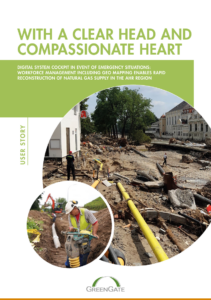
Download the customer story from Energienetze Mittelrhein here as a PDF. If you have any further questions, feel free to get in touch. We look forward to hearing from you.
Whether you have to master similar tasks in your company or face other challenges: check whether GreenGate software can help you. Here you will find related Blueprints that can handle maintenance tasks and solve problems.
That’s why so many companies trust us.



If you have further questions about this case, please call us or fill out the form here. We will get back to you promptly.