
Instandhaltungssoftware für Industrie, Versorger und Windkraft
Reference Customer | Case Study
The Canton of Zurich’s electricity works are integrating visualisation within their geoinformation system with operational management in GS-Service – the ‘Stadtmelder’ portal solution involves the public in the maintenance of street lighting
Consistently high quality of supply is the key priority for the Canton of Zurich’s electricity works (EKZ). In fact, statistically speaking, an EKZ customer is affected by a power cut for just over an hour only once every eight years. “To ensure this remains the case, we invest over 50 million Swiss francs in our network every year,” says the public-law company, which procures and distributes electricity for the Canton of Zurich – excluding the cities of Zurich and Winterthur. Since 2010, EKZ has been managing the maintenance of its assets in the four network regions of Limmattal, Oberland, Sihl and Weinland using the GS-Service operations management system from GreenGate (D/CH).
The scalable maintenance solution is one of these ‘substantial investments’ through which EKZ achieves above-average security of supply: availability figures of 99.998 per cent are exceptional even in Switzerland – a country renowned for its precision.
Since 2010, the Canton of Zurich’s electricity works have been using GS-Service to plan, manage, analyse and document maintenance activities across the four network regions of Limmattal, Oberland, Sihl and Weinland. The integration of visualisation in the geoinformation system with operational management in GS-Service ensures maximum performance and efficient asset management – the ‘Stadtmelder’ portal solution involves the public in the maintenance of street lighting.
GS-Service – GS-Manager; GS-Web; GS-Touch
Digital inventory of infrastructure, equipment and staff in GS-Service; review and analysis of operational processes; integration/linking of the GS-Service operational management system with GIS and ERP; set-up of the ‘Stadtmelder’ citizens’ portal
Since 2010, the Zurich Cantonal Electricity Works have been using GS-Service to plan, manage, analyse and document maintenance activities across the four network regions of Limmattal, Oberland, Sihl and Weinland. The integration of visualisation in the geoinformation system with operational management in GS-Service ensures maximum performance and efficient asset management – the
‘Stadtmelder’ portal solution includes public participation in the maintenance of public lighting.
Dipl.-Ing. Nils Beckhaus, Head of Asset Management, still remembers exactly why GS-Service came out on top at EKZ during the major evaluation of potential maintenance systems in 2009, rather than a solution from Walldorf: “I think the simpler, more appealing user interface and the more intuitive operation were the deciding factors. Added to this were the comparatively better design options with really good customisation.” Given the sheer scale of the operation, a bespoke solution with integrated information on topology, assets and processes is essential: EKZ’s operations management system in GS-Service initially serves as a digital representation of around 2,750 transformer stations, 7,700 distribution cabinets, 70,000 lampposts (lighting points/public lighting), 15,000 masts (support structures), 7,000 photovoltaic systems and 40 substations.
More recently, 10,500 switches and 1,500 protective devices have also been included. “Digitalisation was already being driven forward at EKZ as early as 2000, but the problem was that we still had decentralised systems in the years that followed. Some assets had not yet been digitally recorded at all and existed only as ink drawings, some in Excel, and some in SAP.” That might just about work for static applications, but not for a company responsible for ensuring a secure electricity supply to Switzerland’s largest economic region, with a million end customers. EKZ also sees it as its duty, as a business-minded company, to invest “proactively in the maintenance and expansion of our grid infrastructure”: “In doing so, we rely on both tried-and-tested and new technologies.”
The service area of the Canton of Zurich’s electricity utilities
With the new GS-Service operational management software, EKZ was able to tackle the problem of data disconnects and redundant – and, in some cases, inaccurate – data sources head-on from 2010 onwards. Nils Beckhaus contrasts the old and new approaches to information management: “That is, after all, the real advantage of centralised, digital asset management: everything is in one place – there is no duplicate data entry. Previously, we had several ‘sources of truth’, which raised the question: which one is the right one? It’s entirely conceivable that, in such a case, strategic decisions might be made on the basis of data that does not reflect reality.”
Today, it seems more logical than ever: reliable access to knowledge about the structural and network-topological characteristics of the network infrastructure requires a true-to-life representation of the assets themselves and the associated processes, such as maintenance, inspection and repair. That is why EKZ relies on a highly integrated combination of geovisualisation (GIS) for functional relationships and the GS system for the planning, control, analysis and documentation of assets and maintenance activities.

GreenGate’s GS-Service, as a system subordinate to the ERP, integrates planning, documentation and monitoring functions, as well as business management applications, into a single information and management system for areas such as workforce management, operations management, maintenance and materials management. The object-oriented software – designed as a scalable client/server solution – is based on standard technology and runs on the latest Microsoft operating systems. Thanks to its open system architecture, GS-Service can be integrated with other systems (GIS, ERP, DMS, PLM, CRM, PLS, PLC). In the Canton of Zurich, GS-Service also feeds data into the so-called ‘Stadtmelder’, a portal system for reporting faults via the internet, which relies on active citizen participation to maintain public lighting.

That is, after all, the real advantage of centralised, digital asset management: everything is in one place – there is no need to enter data twice […] Nowadays, I press a button and receive objective information; in the past, I had to spend days poring over files with no guarantee of finding what I was looking for.
Dipl.-Ing. Nils Beckhaus, Head of Asset Management,
Zurich Cantonal Electricity Works

as well as 15,000 poles, 10,500 switches, 7,700 distribution cabinets, 7,000 photovoltaic systems, 2,750 transformer stations, 1,000 protective devices and 40 substations are documented in the GS-Service operations management system.

The Zurich Cantonal Electricity Works (EKZ) invest in their network every year. This comprises 15,446 km of power lines, of which 14,833 km are underground cables and 613 km are overhead lines.

This is ensured by 1,400 EKZ staff, who procure and distribute electricity for the Canton of Zurich – excluding the cities of Zurich and Winterthur.
Stadtmelder is a well-established web interface that local authorities can integrate into their municipal portals. It contains information from the GS system relating to 70,000 street lamps. Residents visit the Stadtmelder website or use the smartphone app to report, for example, a fault with the street lighting on Ueberlandstrasse near house number 2 in 8953 Dietikon, directly at the street lamp in question. Via the interface with the GS system, the responsible network region receives the repair order directly. Confirmation that the repair has been successfully completed is sent back to Stadtmelder from the GS system. Citizens thus also receive positive feedback on their report.
“When it comes to IT systems, there is often talk of reducing complexity,” says René Tobler, Head of IT for the Networks division at EKZ, “the Stadtmelder is perhaps the best example of how information technology can be designed to be practical and serve the direct interests of citizens. Since its launch, the portal solution has been widely embraced and has now become more of an integral part of productive collaboration within the canton than a flagship project of limited effectiveness or duration.” René Tobler elaborates on the idea that whilst software may be sophisticated in its development, its use must be simple: “From an IT perspective, it is always interesting to observe that: the value of an application only truly unfolds when it is put into use.” The fact that EKZ also utilises the natural advantages of integrating information from the GIS and the GS-Service operations management system in the operation of the Stadtmelder may be of less interest to the public, but it forms the technological foundation for the smooth operation of a grid that, after all, accounts for ten per cent of Switzerland’s electricity demand.

Whether you have to master similar tasks in your company or face other challenges: check whether GreenGate software can help you. Here you will find related Blueprints that can handle maintenance tasks and solve problems.
Whether at the operations centre in Dietikon or at the bases in the four network regions around Zurich: a total of around 250 colleagues use the desktop version of GS-Service; of the 40 maintenance staff, 20 use GS-Touch. GS-Touch is a mobile offline application from GreenGate that runs on standard devices (smartphones, tablets, etc.) with common operating systems (Android, iOS). GS-Touch covers standard workflows for tasks, activities and events. This means that the EKZ service engineering team can access tasks on their tablets (iPads)
and works through each task one by one, recording any defects in the maintenance and inspection schedules and reporting completed tasks whilst on the move. In the evening, the systems – and with them the up-to-date information from day-to-day maintenance operations – are synchronised.
The work planning department assesses the defects and, via GS-Service, initiates rectification and further measures where repairs are required. Minor repairs are usually carried out on site as part of standard maintenance. “Pole inspections are an example of maintenance required by law,” says Beckhaus, “with maintenance intervals of two years for medium-voltage poles and five years for low-voltage poles. We carry out all of this through GS-Service.”
All recurring checks are managed via GS-Service; the system generates the tasks and documents their completion. This enables us to fulfil our documentation obligations.” The company takes this seriously, “because a mistake made during data entry just before the end of the working day can lead to a serious misjudgement the very next day.” Whether you call it a domino effect or the propagation of errors: Particularly given the high level of integration between all connected systems (including GIS, GS-Service and SAP), error lists are generated almost daily in GS following data validation to ensure a consistent information network is maintained in the long term. “Naturally, we want to nip these in the bud,” says Nils Beckhaus. In other words, it means getting a little better every day.

“There is often talk of reducing complexity in the context of IT systems. The ‘Stadtmelder’ is perhaps the best example of how information technology can be designed to be practical and serve the direct interests of citizens.”
René Tobler, Head of IT for the
Networks Division, Zurich Cantonal Electricity Works
As Head of Asset Management, Nils Beckhaus — who joined EKZ’s network documentation team in 2006 — particularly values the reporting and analysis capabilities in GS. “Today I push a button and get objective information; in the past, we had to spend days sifting through binders of files with an uncertain outcome. Now we can produce reliable statements much faster, though it’s clear to everyone involved by now that the calculations can only ever be as good as the underlying data quality.” At any time, EKZ can access whichever system is right for the task at hand — both the geographic, topological documentation in the GIS and the database of numerous assets in the GS operations management system: “Even though we always capture information in only one place to avoid duplicate entries, we naturally need a strong link between the two systems,” says Beckhaus. “Nowadays, for example, we already start documentation at the project-planning stage for new equipment. In the GIS, a measure can be located geographically; for more precise information such as fuse ratings or the occupancy of a distribution cabinet, transformer station or substation, we jump directly into GS via the interface. That’s the most important thing: getting information about the equipment.” It’s clear that, much like in manufacturing when setting up a new production line, office-based planning exercises and simulations precede the actual commissioning of newly designed equipment. “During the actual commissioning itself, we’re quite fast — we then only need to record the status change in the system, since the documentation has already been stored.”
The 40 substations, where higher voltages from the supra-regional distribution network are stepped down to medium voltage, are documented in great detail. The maintenance requirements for these are enormous, as they are regarded as critical points. Maintenance here is largely preventative: “The substations,” explains Beckhaus, “are among our most important assets. If one of the substations fails, the power supply is cut off in one-fortieth of the canton. If I cannot receive and transform power from the upstream supplier, I simply cannot distribute it either. That is why we also use redundancy here. In contrast, a street distribution cabinet serves only a handful of customers. So the number of assets increases as you go down the hierarchy, whilst the number of customers per element decreases.”
The central operations control centre (BFS), based on the EKZ island in Dietikon – which is flanked on both sides by the River Limmat – keeps a constant eye on the substations. The BFS monitors the most important grid assets directly and continuously. “If faults occur here,” says Beckhaus, “the grid regions are alerted and called upon to rectify the fault. So that they know what equipment they will find, they naturally need the maintenance system.” And should a replacement transformer need to be installed, an inventory list complete with a maintenance history can be accessed, as this is also recorded in GS-Service.
In the foreseeable future, EKZ’s maintenance teams will increasingly access on-site information via the GS-Web mobile solution, which, like GS-Touch, has been available on tablets since summer 2021. GS-Web is the browser-based application (intranet/internet) for viewing, editing and analysing content from the GS system. Maintenance staff visit a website, log in and get started on specific tasks. The new software is aimed at various stakeholders within the company, including senior management, who can make use of the dashboards. Dashboards are maintenance KPIs; they present key figures relating to maintenance processes, faults, breakdowns, etc. in graphical form.
GreenGate promotes GS-Web with the slogan ‘Radically simple’, but is that really the case? René Tobler from EKZ-IT offers a nuanced view: “An IT administrator or computer scientist will certainly assess the simplicity of the application differently from a maintenance engineer or a business analyst in the controlling department. But it’s certainly true: GS-Web quickly finds its way into day-to-day working practice, not only because of its capabilities, but primarily because of its intuitive operation.”
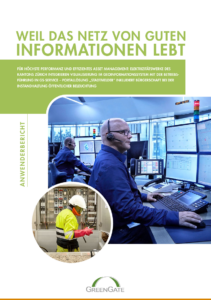
Download the EKZ customer case study as a PDF here. If you have any further questions, please feel free to contact us. We look forward to hearing from you.
That’s why so many companies trust us.


If you have further questions about this case, please call us or fill out the form here. We will get back to you promptly.