Instandhaltungssoftware für Industrie, Versorger und Windkraft
Reference Customer | Case Study
The software solution from GreenGate AG (D/CH) is not only the leading system at Omexom Offshore for technical operations management and the execution of maintenance work orders. By integrating various wind farms, different operators and various external service providers, GS-Service also represents the preferred digital platform for the “Offshore North Sea labor market.” And that market is gigantic.
GS-Service – GS-Manager; GS-Web; GS-Touch; GS-PeopleTracking; Permit service
Digital recording of plant infrastructure, equipment and personnel in GS-Service; inventory and analysis of operating processes; development of the Permit to Work system; integration with ROTORsoft (plant monitoring and surveillance)
Omexom Offshore uses GS-Service to manage the entire operational process of technical operations management for offshore wind farms (planning, work preparation, resource management, execution and follow-up of maintenance activities, documentation, optimization).
The software solution from GreenGate AG (D/CH) is not only the leading system at Omexom Offshore for technical operations management and the execution of maintenance work orders. By integrating various wind farms, different operators and various external service providers, GS-Service also represents the preferred digital platform for the “Offshore North Sea labor market.”
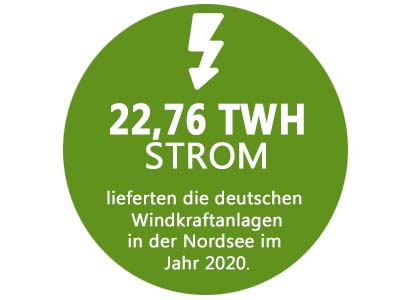
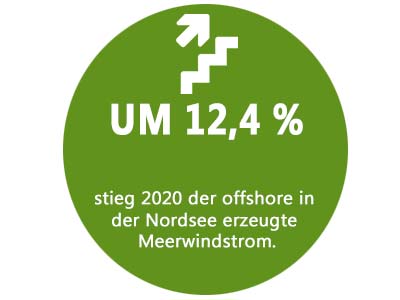
And that market is gigantic. In 2020, wind power plants in the North Sea supplied more electricity than ever before. The total amount produced rose by 12.4 percent compared to 2019, to 22.76 terawatt-hours (TWh).
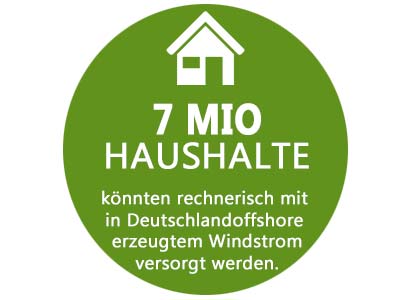
Comparing this to the 4.13 TWh from German Baltic Sea wind farms quickly shows why the North Sea in particular is considered a powerhouse. The offshore wind power currently generated in Germany could theoretically supply seven million households.
Whether as project developer, technical consultant or technical operations manager: Omexom Offshore and offshore services in the North Sea are frequently mentioned in the same breath. After all, under the direction of these offshore experts, “alpha ventus” became the world’s first offshore wind farm under high-seas conditions to go into operation in 2010 (total capacity 60 MW). And “Riffgat” was the first commercial offshore wind farm to deliver power from the German North Sea, in 2013. With 30 wind turbines and a total installed capacity of 113.4 megawatts, Riffgat today supplies climate-friendly energy for 120,000 households.
This was followed by contracts for the operation and maintenance of the substations in the Trianel Borkum West wind farm (total capacity 200 MW), as well as the GEMINI and Merkur wind farms in 2017/2018. In addition, the construction of Trianel Borkum West II was carried out; its operational management is also in the hands of Omexom Offshore, specifically the substation and the transition pieces that connect the foundation and steel tower of each wind turbine. Since July 2020, the rotors of 32 wind turbines have been turning at Trianel 2, supplying green electricity for around 200,000 households per year. Omexom Offshore’s portfolio also includes maintenance services for the Nordergründe wind farm (client: DWT), Luchterduinen & Prinses Amalia, Borssele III and IV, Blauwwind and Borssele V / Two Towers (client: ENECO), as well as GODEWIND I and II (client: Ørsted).
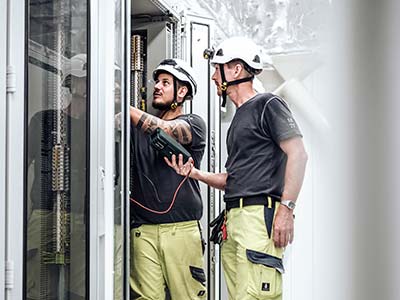
Almost all departments use GS-Service – whether it’s the employee at a stationary PC in the 24/7 control room at the Oldenburg headquarters, warehouse staff on a laptop at the Borkum service base, or the tablet-savvy service technician on one of the central offshore substation platforms.
To manage the millions of objects, assets and pieces of equipment in total, Omexom Offshore uses GS-Service. Software for operations management, maintenance and services is exactly what such specialized service providers as Omexom Offshore need: an IT cockpit with which all technical and legal tasks and states are initiated, documented, reviewed and administered. Almost all departments use GS-Service – whether it’s the employee at a stationary PC in the 24/7 control room at the Oldenburg headquarters, warehouse staff on a laptop at the Borkum service base, or the tablet-savvy service technician on one of the central offshore substation platforms. External service providers commissioned to carry out maintenance (servicing, upkeep, repair) on the wind turbines above the boat-landing platform (including tower, nacelle, hub, rotor) can also access GS-Service via mobile applications. That’s because here, everything from personnel to processes to objects is stored in a single, consistent data source.
“In fact, the GS-Service system landscape is the leading system and is used by all departments,” explains Dustin Schuchholz, system administrator and user support specialist in the Projects/IT department, who is responsible for GS-Service at Omexom Offshore. “The entire operational process of technical operations management,” adds Kira Müller, project manager for organizational strategies in the Operations Management department, “is mapped in GS-Service – from planning and work preparation, including resource management, through execution and follow-up, all the way to documentation and optimization.” That’s as comprehensive as it sounds; the IT buzzword “single source of truth” takes on a whole new meaning here.
Kira Müller: “We provide all of these services with the support of the GS systems. The data, in turn, forms the basis for evaluation, analysis, reporting and optimization.” In concrete terms, this means that all planned and unplanned service assignments are generated from the GS-Service database as part of day-to-day operations.
Maintenance and repair work orders are created via a system connected to GS for plant monitoring and surveillance, which processes fault reports from the turbines.
All tasks relating to maintenance, fault clearance and defect resolution – in four out of five cases presented as a checklist with at least three sub-items – are pushed to the individual service teams’ mobile devices, which are also integrated into the system. This is done via tools such as GS-Touch and GS-Web. GS-Touch maps GS-Service’s standard order management (tasks, activities, defects) on any mobile device (smartphone, tablet or PC), including offline. Among other things, the app offers an up-to-date daily task overview, on-the-go reporting of completed activities, spontaneous defect logging and direct time booking. Omexom Offshore uses the GS-Web module, available via intranet or internet, to “improve collaboration with service providers, coordination with customers and for reporting,” explains Kira Müller. GS-Web is a browser-based application: in practice, the maintenance technician logs in via tablet, smartphone etc. on a website and can view task lists, shift schedules, inventory levels, project progress and object-specific details such as wiring diagrams in the machine room, as well as report completed activities, working hours etc. “Although we don’t yet use time recording company-wide at GS,” reports Dustin Schuchholz, “the planned next steps are expanding cost controlling and further developing resource scheduling.”

We support safety-critical activities by flagging hazard potential, recording occupational safety regulations, and monitoring employee qualifications in GS-Manager.
Dustin Coers, System Administrator and User Support Specialist, Projects/IT Department, Omexom Offshore
Whether you have to master similar tasks in your company or face other challenges: check whether GreenGate software can help you. Here you will find related Blueprints that can handle maintenance tasks and solve problems.
As a system positioned downstream of the ERP (Enterprise Resource Planning), GS-Service integrates planning, documentation and monitoring functions as well as business management applications into a single information and management system. The object-oriented software – designed as a scalable client/server solution – is built on standard technology and runs on current Microsoft operating systems. Advantage: thanks to its open system architecture, GS-Service can be linked to other systems.
Work within GS at Omexom Offshore is supported by a commercial ERP system, by JIRA & Confluence for knowledge and organizational management, and a document management system (instruction management system). GS-Service is already linked via an interface to ROTORsoft (plant monitoring and surveillance). Events occurring in monitoring are either fed in automatically via ROTORsoft or logged manually as an event.
Linking GS-Service to the ERP system is just as conceivable at Omexom Offshore as a possible interface to the planned reporting tool. A clear case for GreenGate. The continuation of the GS-Service success story at Omexom Offshore has been based, since implementation in 2016, on very close collaboration with system provider GreenGate: Dustin Schuchholz: “We’re talking about a cooperative, fair partnership with great support. GreenGate brings a deep understanding of our processes and needs. That’s necessary because offshore is challenging: a very specific dynamic has to be mapped in the system here.” Omexom Offshore always prioritizes the safety factor in this regard.
With GS-Service, service deployments can be planned much more quickly and reliably. Instead of up to three days in advance, deployment managers can now finalize plans in the morning before departure.
Frank Lagemann, Board Member GreenGate AG
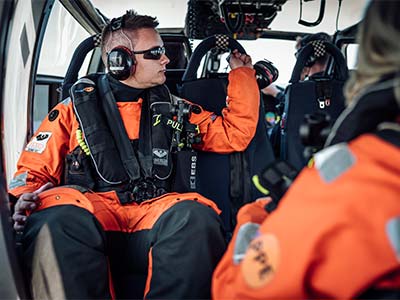
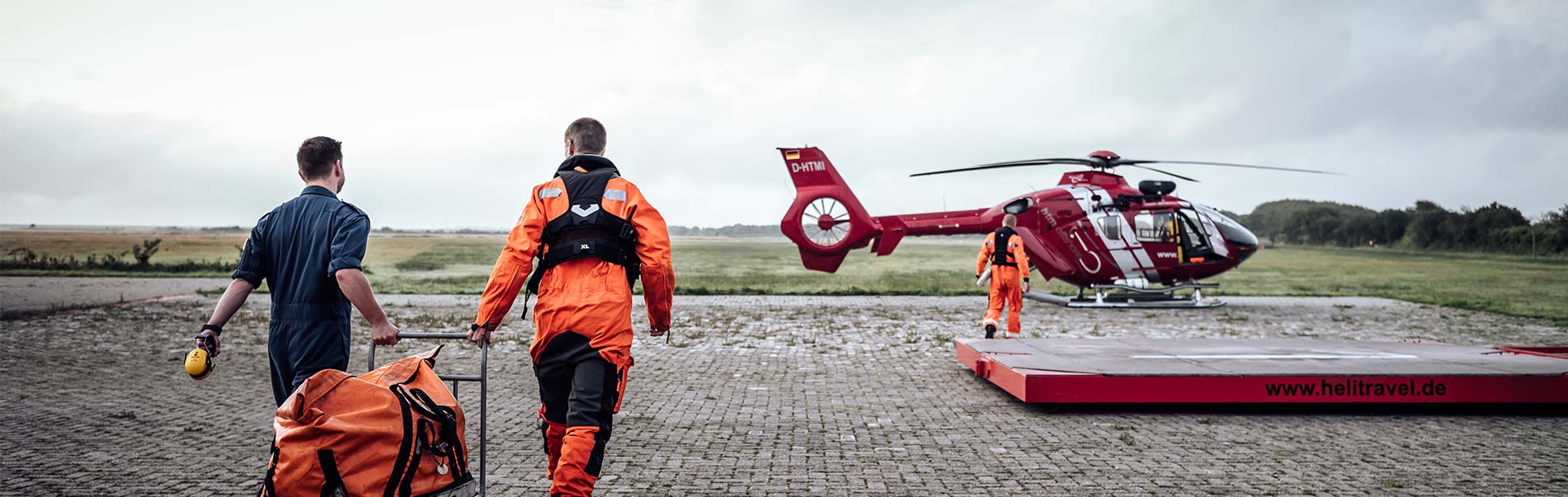
Just as a wind farm operator doesn’t greenwash but actually produces green electricity, protecting the health and safety of employees and service providers is no PR phrase either. It has to be guaranteed. Because pleasantly warm, windless days on a mirror-smooth sea are a dream for every service technician, but in the North Sea they are more a once-in-a-century event than the rule. This means Omexom Offshore’s service technicians are closely accompanied by and through GS-Service — from boarding the ship or helicopter, through the on-site assignment, to their return to land.
“We support safety-critical activities,” says Dustin Coers, “by flagging hazard potential, recording occupational safety regulations, and monitoring employee qualifications in GS-Manager.”
Anyone servicing and repairing offshore wind turbines as a service technician simply has to be qualified, and needs far more than a head for heights and sea legs. Electronic, mechanical engineering or hydraulic knowledge must be taken into account, as must a health certificate, first-aid and climbing know-how, HUET (Helicopter Underwater Escape Training), and Basic Safety Standards (First Aid, Manual Handling, Fire Awareness, Working at Heights, Sea Survival), among others. Relevant personnel information is therefore also meticulously recorded and continuously updated in the GS database by external service providers, so that the web-based Permit to Work system integrated into GS only actually allows qualified personnel onto the service vessel, the substation facilities and the wind turbines. This system takes considerable work off the shoulders of the Omexom dispatcher, who can access previously stored employee data for every assignment, regardless of which wind farm is involved. Ultimately, GS-Service automatically cross-checks the upcoming service activity against both the plant data and the employee qualifications stored in the system.
What’s more: GS-Service maps the work-permit process itself and documents it for traceability. Schuchholz: “In GS-Service, we’ve also implemented monitoring of equipment inspections, mapping of DGUV [German statutory accident insurance] requirements, control and monitoring of personal protective equipment and rescue equipment, and monitoring of the logistics deployed by our service providers.”
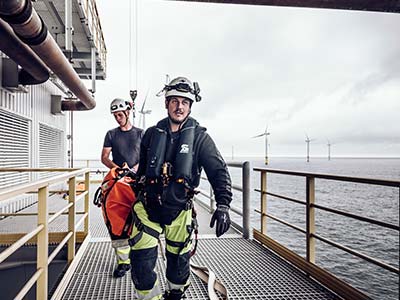
Accordingly, the system itself contains information such as the draft of a service vessel or the maximum permitted number of passengers. Finally, people tracking, which the control center carries out using GS-Service, is essential. Nowhere else is safety such a potentially variable state as at sea. Anything other than a software-supported tracking solution — which requires all employees, from the dispatcher in the control room to the service technician on site, to act in a safety-compliant manner and pay attention to one another — would be negligent given the surrounding conditions.
In practice, the maintenance technician logs in via tablet, smartphone etc. on a website and can view task lists, shift schedules, inventory levels, project progress and object-specific details such as wiring diagrams in the machine room, as well as report completed activities, working hours etc.
At Omexom Offshore, effectiveness in protecting people and nature naturally goes hand in hand with the imperative of efficiency. On the one hand, it’s about further maximizing performance output in wind farm operation — after all, only a turning wind turbine earns money and helps the climate. On the other hand, maintenance at sea is, compared to classic industrial maintenance, not just a few percentage points more expensive offshore, but several factors more costly.
This is where the benefits of using GS-Service come directly into play — GreenGate Executive Board member Frank Lagemann explains why: “With GS-Service, service missions can be planned much more short-term and more safely. Instead of up to three days in advance, the mission control team can now finalize the last planning steps in the morning before departure.” This alone is a major benefit, since arrivals and departures of the service vessel represent significant costs on their own
In the past, it was not uncommon for ships to have to make multiple trips to supply service technicians with the spare parts they needed. Lagemann continues: “To be able to account for the right time windows, weather services are of course also integrated into the software. Wave height is also factored in here as a safety-critical condition, particularly during the transfer from the boat to the external platform.” Ideally, this makes it possible to combine calm seas and low wind with curtailing the wind turbine for maintenance and repair.
We’re talking about a cooperative, fair partnership with great support. GreenGate brings a deep understanding of our processes and needs. That’s necessary because offshore is challenging: a very specific dynamic has to be mapped in the system here.
Dustin Schuchholz, System Administrator and User Support Specialist, Projects/IT Department, Omexom Offshore
Kira Müller and Dustin Schuchholz are well aware that the success of any software — no matter how good it is — depends on acceptance-based use by colleagues in-house. Neither of them are IT novices; instead, they deliberately rely on the participation of multipliers in all departments: “By introducing the key-user concept, we were able to win over employees from almost all departments. They play a decisive role in communicating with their departments and act as an interface to the administrator.” The key-user concept is supported by an internal training program as well as regular meetings for exchange between system administrators and departments.
Dustin Schuchholz: “There’s a regular exchange here about wishes, ideas, improvements and further use of the systems. Everyone has access to the system, and colleagues work creatively with it and actively look for use cases we haven’t yet mapped.” And the feedback after five years in use? “Consistently positive,” reports Kira Müller. “More and more runs through GS-Service all the time. Colleagues are convinced that working in the system makes day-to-day operations easier and that processes become leaner and more transparent. The software can do a lot and is incredibly flexible. We also receive consistently positive feedback from customers.”
Download the Omexom case study as a PDF here. If you have any further questions, please do get in touch. We look forward to hearing from you.
That’s why so many companies trust us.


If you have further questions about this case, please call us or fill out the form here. We will get back to you promptly.